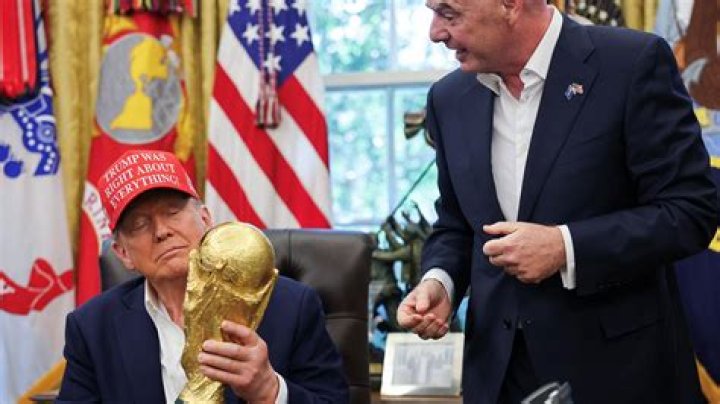
Donald Trump’s iron grip on the Republican Party has been clear since the day he announced he would make another run for the White House 14 months ago. It can be seen in the party’s ideological shift even further to the right on cultural issues and, especially, on immigration policy.
Iowa Republicans were a clear reflection of that on Monday night, delivering the former president an emphatic victory. They channeled his anger, and his view that basically everything President Joe Biden has done has been a “disaster.” About 9 in 10 voters said they want upheaval or substantial change in how the government operates, according to AP VoteCast, a survey of more than 1,500 voters who said they planned to take part in the caucuses.
As clear-cut as his win was, though, Iowa has not historically played the role of kingmaker in the Republican nominating process. New Hampshire’s voters don’t take their cues from Iowa.
Here are some key takeaways:
AN INCUMBENT CAMPAIGN
This was the least suspenseful Iowa caucus in modern memory because Trump has essentially been running as an incumbent president. He’s convinced many Republicans he didn’t really lose the 2020 election to Biden, repeatedly making false claims, and has dominated the race the way someone still in office does.
He traveled sparingly to the state, holding a modest number of rallies. He spurned candidate debates. He chose to appear at court hearings as a defendant in his legal cases in New York and Washington rather than speak to Iowa voters in the final days before the voting.
The former president, who remains the party’s dominant favorite, clearly wants to move on to the general election as quickly as possible. In his victory speech, he tried to portray the race as all but over, and a candidate known for his propensity for division asked his party and the nation to come together, praising rivals he had spent months denigrating. But Iowa winnows the field more than it determines the winner.
NO ‘FRAUD’?
After a “decisive” loss in Iowa 2016, Trump went on the attack. A pattern he repeated after losing to Joe Biden in the 2020 general election.
“Ted Cruz didn’t win Iowa, he illegally stole it. That is why all of the polls were so wrong any [sic] why he got more votes than anticipated. Bad!” Trump tweeted at the time. “Based on the fraud committed by Senator Ted Cruz during the Iowa Caucus, either a new election should take place or Cruz results nullified.”
Trump also told Boston Herald Radio that he’d likely sue: “I probably will; what he did is unthinkable.”
Trump has repeated his arguments the 2020 presidential election that he lost was “stolen” and that U.S. elections in general are “rigged.” There is no evidence that the 2020 election was stolen. Dozens of lawsuits were dismissed by courts and government and independent reviews have not found enough alleged fraud to throw the outcome into question.
On Monday, Trump accepted his win in the Iowa Caucuses, saying that “this is the third time we’ve won.”
TWISTS AND TURNS AHEAD
Inevitable can be a dangerous word, especially in New Hampshire, which holds its primary in eight days.
New Hampshire has famously delivered upsets in both parties. Former South Carolina Gov. Nikki Haley quipped that New Hampshire “corrects” Iowa. George W. Bush felt New Hampshire’s sting in 2000 when Senator John McCain defeated him. So did former vice president Walter Mondale when Senator Gary Hart of Colorado scored an upset in the Democratic race in 1984.
With its more moderate, educated electorate, New Hampshire presents Trump’s rivals with possibly their best opportunity to slow his march. Haley is hoping for a win there or at least a very strong showing, as is Florida Gov. Ron DeSantis, who edged Haley out for second place in Iowa but trailed Trump by about 30 points.
After that comes a weird political lull — with the next major competitive race in South Carolina on Feb. 24.
But plenty can happen during that time. The U.S. Supreme Court on Feb. 8 is scheduled to hear arguments in a case challenging whether a constitutional clause banning those who “engaged in insurrection” from holding office applies to Trump. The high court may also weigh in on whether presidential immunity protects Trump from federal charges for trying to overturn his 2020 election loss.
The criminal trial, in that case, is scheduled to start on March 5 — Super Tuesday — when 14 states vote in the presidential nominating process. Trump’s strength among Republican voters is beyond dispute, but the road is long and could be bumpy.
IT’S NOT THE ECONOMY
Iowans had something on their minds, but it wasn’t jobs, taxes or business regulations.
About 4 in 10 caucus-goers said immigration was their top issue, compared to 1 in 3 picking the economy, according to VoteCast. Other priorities like foreign policy, energy and abortion ranked even lower.
Indeed, about two-thirds of caucusgoers said they felt their finances were holding steady or improving. But the voters still want major changes — 3 in 10 want a total upheaval of how the federal government runs while another 6 in 10 want substantial changes. Additionally, as Trump faces multiple criminal charges, 6 in 10 caucusgoers don’t have confidence in the U.S. legal system.
It adds up to a portrait of a slice of the electorate eager to challenge core democratic institutions in the U.S.
DESANTIS’ DISMAL RETURN ON INVESTMENT
Flush with more than $100 million in cash and fresh off a blowout reelection victory, Florida Gov. Ron DeSantis entered the 2024 Republican presidential contest projecting himself as the heir to a MAGA political brand that a diminished Trump could no longer effectively carry.
Reality soon intruded.
Eight months and tens of millions of dollars later, DeSantis posed little threat to the former president in Iowa. Still, he vowed to continue his campaign and said he had “punched his ticket” out of Iowa with his second-place finish.
Despite more than $55 million in pro-DeSantis advertising spending, the Florida governor only narrowly bested Haley.
DeSantis has been dogged by negative stories about profligate spending, including DeSantis’ preference for flying private planes.
His next challenge will be whether donors will continue to support him.
THE EDUCATION DIVIDE
More than half of Haley’s voters had at least a college degree and roughly half of DeSantis’ did, according to VoteCast. But only about 2 in 10 of Trump’s did.
Education has been a major dividing line among white voters during the Trump era. Iowa confirms what polling has indicated during the primary — that the education divide is also splitting the GOP.
That hints at a possible weakness for Trump in November, should he be the nominee. A greater share of the voting public has at least a bachelor’s degree now than in 2016, and that share rises every year as degrees become more popular.
Another indication of vulnerability for Trump came in the suburbs, which tend to have the highest levels of education. Only about 4 in 10 caucusgoers there supported him. The suburbs were pivotal in Biden’s 2020 victory over Trump.
RAMASWAMY PUNCHED HIMSELF OUT
Abrasive, often grating and very online — Vivek Ramaswamy’s quixotic bid for the White House has come across as a millennial distillation of Trump’s Make America Great Again political movement.
Ramaswamy rapped along to verses of Eminem, delighted in trolling his rivals and often sought to out-Trump Trump with his brash rhetoric. That performative aspect helped the wealthy 38-year-old entrepreneur gain considerable attention in the early days of the Republican White House contest.
But it also proved to wear thin, perhaps summed up best when former New Jersey governor Chris Christie called him the “most obnoxious blowhard in America” during a debate.
As returns from Iowa’s caucus posted, Ramaswamy seemed unlikely to reach double digits, and he suspended his campaign.
OVER BEFORE IT STARTED?
In some ways, Iowa’s Republican caucuses were practically over before they even started, with Donald Trump cultivating a deep network of support over three presidential runs.
Seven in 10 Iowans who caucused for Trump on Monday night said they have known all along that they would support the man who has remade the Republican Party through his “Make America Great Again” political movement. Trump was carried to victory by the majority of caucusgoers who say they back it, a sign of his growing influence in a state that denied him a victory eight years ago.
His chief challengers — Florida Gov. Ron DeSantis, former South Carolina Gov. Nikki Haley and biotech entrepreneur Vivek Ramaswamy — tried to carve out their own coalitions. But none could match the demographic edges enjoyed by Trump in this year’s first presidential contest, according to the findings from AP VoteCast. Ramaswamy suspended his campaign after a disappointing finish in the caucuses.
Trump performed strongly in small town and rural communities, where about 6 in 10 caucusgoers said they live. He won with white evangelical Christians, who made up nearly half of the caucusgoers. He excelled among those without a college degree: 62% of caucusgoers in that group chose Trump.
If there is a reason for pause in his Iowa success, it is that many of the must-win states in the November general election are more urban, more suburban, more racially diverse and have slightly more college graduates as a percentage of their adult population than does Iowa.
AP VoteCast is a survey of more than 1,500 voters who said they planned to take part in the caucuses. The survey is conducted by The Associated Press-NORC Center for Public Affairs Research.
HOW TRUMP WON IN IOWA
The 77-year-old Trump entered Iowa as the caucus favorite, and AP VoteCast showed why he has become a juggernaut among GOP voters in the state.
The demographics favored him, but so did the issues that people prioritized: immigration and the economy.
Among the roughly 4 in 10 Iowa caucusgoers who identified immigration as the most important issue for the nation, 59% backed Trump. Those participating in the caucuses agreed with his hard-line stance on finding ways to limit immigration.
About 9 in 10 backed building a wall along the U.S.-Mexico border, with about 7 in 10 expressing strong support for the idea first championed by Trump during his 2016 campaign. The vast majority, three-quarters, said immigrants do more to hurt than help the United States, an indication there is a desire to reduce overall immigration levels.
About one-third of caucusgoers prioritized the economy. Of those who selected it as their top issue, 53% supported Trump.
DESANTIS’ DISTANT SECOND
The key for DeSantis earning a second-place finish was the backing of conservatives, who favored him over Haley — even though they liked Trump most of all. About 7 in 10 Iowans who caucused defined themselves as conservatives. About two-thirds of the caucusgoers favored a ban on abortion after six weeks of pregnancy, and DeSantis performed slightly better than Haley among that group.
Haley finished narrowly behind DeSantis. She was the top candidate of the most anti-Trump Republicans in the state, including those who said the former president did something illegal in one of the pending criminal cases against him. She was also the top choice for Republican caucusgoers who voted for Biden in the 2020 election: two-thirds of them supported Haley. But she faced headwinds in a state that largely saw itself as loyal to Trump and his agenda.
DeSantis performed best among the caucusgoers dissatisfied with Trump but who said they would ultimately vote for him in the general election.
Most Iowa caucusgoers for either Haley or DeSantis said they would be dissatisfied with Trump as their party’s nominee. But unlike DeSantis’ backers, two-thirds of Haley’s caucusgoers say they would not ultimately vote for Trump in the general election.
POTENTIAL WEAKNESSES FOR TRUMP
Iowa also exposed some national vulnerabilities for Trump, who lost his 2020 reelection bid to Democrat Joe Biden.
The suburbs were a relative weakness for Trump. That’s a key challenge because AP VoteCast showed nearly half of voters in the 2020 general election said they lived in the suburbs. Only about one-third of Iowa Republicans in the suburbs supported him. Still, neither of his closest rivals bested Trump in the suburbs: about 3 in 10 Iowa caucusgoers in the suburbs also supported both Haley and DeSantis, respectively.
Nor did Trump have as much appeal with college graduates. About 2 in 10 of Trump’s Iowa backers held a college degree, compared with roughly half of those who backed DeSantis and slightly more than that for Haley.
And there are Trump’s legal troubles.
He was indicted multiple times in 2023 and faces the risk of one or more criminal convictions. But that appears so far to have done little damage to his standing with Republican voters.
Still, about one-quarter said Trump has done something illegal when it comes to at least one of the legal cases he is facing: his role in the Jan. 6, 2021, riot at the U.S. Capitol, his alleged attempts to interfere in the vote count in the 2020 presidential election or the discovery of classified documents at his Florida home that were supposed to be in government custody.
NO TO THE STATUS QUO
Caucusgoers wanted to give Republicans the green light to dramatically alter how the federal government operates. Some showed an exhaustion with what they perceived to be politics as usual and a distrust of government institutions.
Many envisioned something of a demolition project for how the country runs. About one-third said they are seeking a complete and total upheaval. An additional 56% of caucusgoers said they want substantial changes.
The vast majority of caucusgoers trusted Iowa elections, but about 4 in 10 were not too confident or not at all confident in the integrity of elections nationwide. Nearly 6 in 10 said they have little to no confidence in the American legal system.
AP VoteCast is a survey of the American electorate conducted by The Associated Press-NORC Center for Public Affairs Research for AP and Fox News. The survey of 1,597 voters was conducted for eight days, concluding as the caucuses begin. Interviews were conducted in English and Spanish. The survey combines a random sample of registered voters drawn from state voter files and self-identified registered voters selected from nonprobability online panels. The margin of sampling error for voters is estimated to be plus or minus 3.4 percentage points. Find more details about AP VoteCast’s methodology at