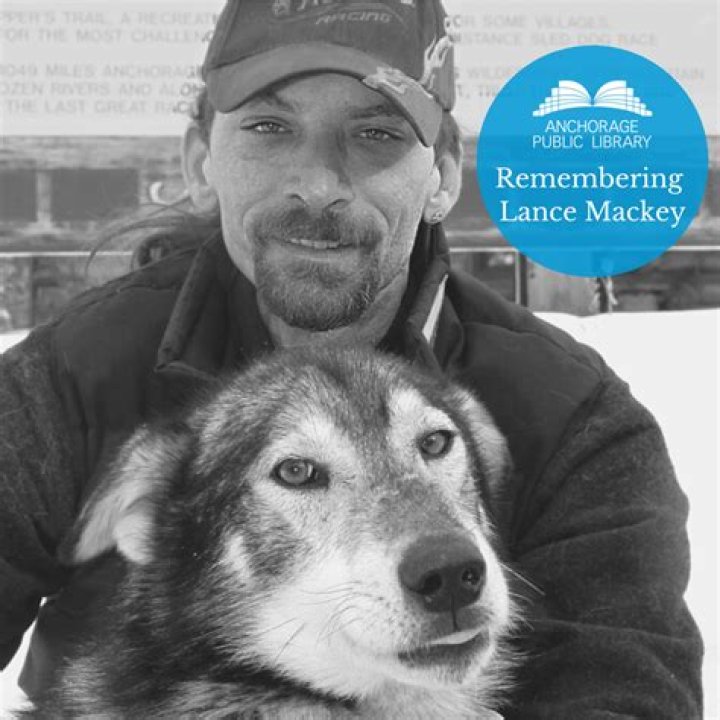
Lance Mackey, who was well-known, died not too long ago. At the time he died, he was 52 years old. His father posted on his official Facebook account that he had died, which was a sad thing to hear.
Lance Mackey died on Wednesday after fighting cancer for a long time. Back in 2001, Lance was told that he had throat cancer.
Even so, radiation therapy and surgery helped Lance beat throat cancer. When they heard this, all of his fans and people who liked him were very happy. They were all glad to hear that Lance, their favorite, had beat cancer. But recently, in the year 2021, Lance said that he had been told he had Cancer again. All of his fans and people who liked him were very upset by this news. Lance Mackey won the Iditarod four times in a row. He was the most interesting and accomplished musher champion. Lance’s father was the famous Iditarod winner Dick Mackey. In 1978, Dick was the winner of the Iditarod. In 1983, his brother Rick Mackey was also the champion. Lance won four times as well.
From 2007 to 2010, Lance was the champion for four years in a row. Lance had won for four years in a row, but he was sick and couldn’t keep it up. Reports have said that drug use was also a big reason why health was getting worse. He couldn’t win again because he was sick for a long time and used drugs. Back in 2001, he also had throat cancer, so the disease had also come back. Reports also say that the treatment made his salivary glands swell and that his teeth fell out. After this, Raynaud Syndrome was also found in Lance. Everyone is shocked and saddened by the news of his sudden and sad death.
All of his fans and admirers were very sad when they heard about his death. Fans and people who liked him wrote heartfelt tributes and condolences on the official post that said he had died. Many people all over the country looked up to him. His family, friends, and fans will always miss him. He was a brave man who fought cancer and beat it once, but couldn’t beat it the second time. We also send our deepest respects and condolences to Lance Mackey’s family and friends. At the moment, there isn’t much known about his personal life. At the moment, there is not much known about his family. Our research team is looking into it, and we will let you know soon what they find. Stay tuned with us for all the latest updates, news, and information from around the country and the world.
Career
Lance Mackey’s career as a sled dog musher started in 2001, when he ran in the Iditarod for the first time. He finished 36th out of the 57 people who finished the race, and he won only $1046.00. By 2007, Mackey had moved up the ranks quickly and was the first person to win both the Yukon Quest and Iditarod in the same year. Mackey kept setting high standards. In 2008, he won the Tustumena 200, then won the Yukon Quest for the fourth time in a row and the Iditarod for the second time. Lance won his third straight Iditarod in 2009, but he didn’t run the Yukon Quest that year. In 2010, he came back and finished second in the Yukon Quest and won his fourth straight Iditarod. However, he fell out of the top ten in the 2011 race, which upset many news reporters. On May 7, 2020, the Iditarod said that Lance Mackey’s 21st place finish at the 2020 Iditarod would be taken away because he failed a drug test. When a sample of Mackey’s urine was taken in White Mountain, as is standard for the first thirty mushers to arrive at the checkpoint, it was found to contain methamphetamine. After this setback, Mackey chose not to run in the Iditarod in 2021.
Kennel rules and dog care
Mackey ran his “Comeback Kennel” on a 5-acre plot of land near Fairbanks, Alaska. One of his most famous dogs, “Zorro,” was born in 2000, and at one point, Mackey’s whole team was made up of Zorro’s offspring. After a snow machine accident during the 2008 All-Alaskan Sweepstakes, Zorro’s career was cut short. Even though Zorro lived and was able to walk again after months of acupuncture and physical therapy, he was never able to compete again.
Some of the things Mackey did at his kennel were criticized in public, especially the way he treated his dogs with CBD. In response to criticism, Mackey defended the way he cares for the dogs and said that giving them CBD helps them get better faster. In a public statement, PETA said that Mackey was wrong and that dog racing was cruel. After two of Lance’s dogs died during the 2015 Iditarod for unknown reasons, they got a lot of bad press.
The beginnings
Lance came from a family of dog sled drivers. Dick Mackey was one of the people who started the Iditarod Trail Sled Dog Race. In 1978, he beat Rick Swenson by one second to win the race. In 1983, Rick Mackey, who is Lance’s half-brother, also won the Iditarod Trail Sled Dog Race. On their sixth try, all three of them won the race while wearing bib number 13.
Mackey has been racing since he was a child. His father remembers building a sled for him when he was old enough to hold on and then watching him win his first race. However, technically, Mackey’s first race was in his mother’s womb, as she placed fourth in the Women’s North American Championships when she was seven months pregnant with him.
Mackey’s parents split up when he was young. Lance says that when he was a teenager, he was arrested more than once for different reasons. After living with her for a while, Lance’s mother sent him to the Coldfoot Truck stop to live with his father. Lance then became a fisherman for a while before going back to what he was meant to do as a dog sled musher.
Personal life
In 2001, Mackey was told he had throat cancer. Even though he was told this, he didn’t let it stop him from working and entered the 2002 Iditarod race. But he would not be able to finish that race. Mackey had to drop out of that race because his cancer treatment, which included a feeding tube, caused problems. He had to take a year off from racing to get better. His cancer was thought to be gone after he got radiation treatment that made his teeth fall out. Mackey had to deal with more than just cancer. He also had Raynaud’s syndrome, which was often made worse by the cold. Mackey’s finger was in so much pain because of this syndrome that he chose to have his left index finger cut off.
Mackey was open about his struggles with addiction in his personal life. Lance said he would go to rehab after testing positive for methamphetamine during the 2020 Iditarod. He has also talked in the past about his problems with cocaine and alcohol.
Mackey has been married three times and divorced twice. On October 4, 2020, Mackey’s partner, Jenne Smith, died tragically in an ATV accident. Mackey and Smith had two children, Atigun and Lozen, who were both under five years old at the time of the accident.
Mackey died on September 7, 2022, from throat cancer. He was 52 years old.
Awards and achievements
In 1990, Carolyn Shoemaker and David H. Levy found the asteroid 43793 Mackey at the Palomar Observatory. It was named after him.
In 2015, an independent full-length movie called The Great Alone was made about Mackey. It was a documentary about his life and work.
In 2010, Lance was recognized in public by the U.S. Senator Lisa Murkowski congratulated him on winning the Iditarod for the fourth year in a row, and she praised him for being determined and persistent in both his personal and professional life.
Mackey grew up in Alaska. His father was a champion musher, so he learned about dogsled racing from a young age. When he was a little boy, his father helped start the Iditarod Trail Seppala Memorial Race, which was later renamed the Iditarod Trail Sled Dog Race. It ran between the Alaskan cities of Anchorage and Nome for about 1,100 miles (1,770 km). It became the most important competition in the sport. Mackey was one of four brothers who had raced since they were young and who would later run in the Iditarod. His father won the Iditarod in 1978, and his oldest brother, Rick, won it in 1983.
Lance Mackey has been a musher since, as he says, “the day I was born.” Before entering the Iditarod, Mackey competed in the Jr. Iditarod Sled Dog Race, which began in 1978 as a place for people who wanted to run the Iditarod to train. In 1988, he came in fourth place in the youth race. In 2001, he took part in the Iditarod for the first time. He finished 36th out of 57 people. In the same year, he was told he had cancer in his throat. After surgery and radiation treatments went well, Mackey ran the Iditarod in 2002 while still using a feeding tube. Because his health was bad, he had to stop running halfway through the race. He took the next year off to get better. Mackey named his kennel the Comeback Kennel to honor the fact that he had to deal with health problems but was eventually able to compete again.
In 2004, Mackey went back to the Iditarod and came in 24th. He also started competing in the Yukon Quest, a 1,000-mile (1,609 km) dogsled race from Fairbanks, Alaska, to Whitehorse, Yukon, Canada. He still ran in that race every year. From 2005, when he was new to the race, until 2008, he came in first every year. This made him the first person to win the event four times. Before the 2007 Iditarod, Mackey had never done better than seventh, but that was the year he won for the first time. He was also the first musher to win both the Yukon Quest and the Iditarod in the same year. In 2008, he did it again by winning both races. With his win at the Iditarod in 2009, Mackey joined Susan Butcher and Doug Swingley as the only mushers to win the race three times in a row. On March 16, 2010, Mackey became the first person to win the Iditarod four times in a row. The race took him less than nine days, which was his best time ever.
Mackey kept running in the Iditarod, but his results were getting worse. Also, after the 2020 race, in which he came in 21st, it was reported that he had tested positive for methamphetamine and was disqualified. Mackey later said that he was going to a facility for drug treatment. In October 2020, his partner, who was also the mother of his two children, died in an ATV accident. This caused him even more trouble. The next year, Mackey said that he had been told he had cancer again. He did not run in the Iditarod in 2021 or 2022.